


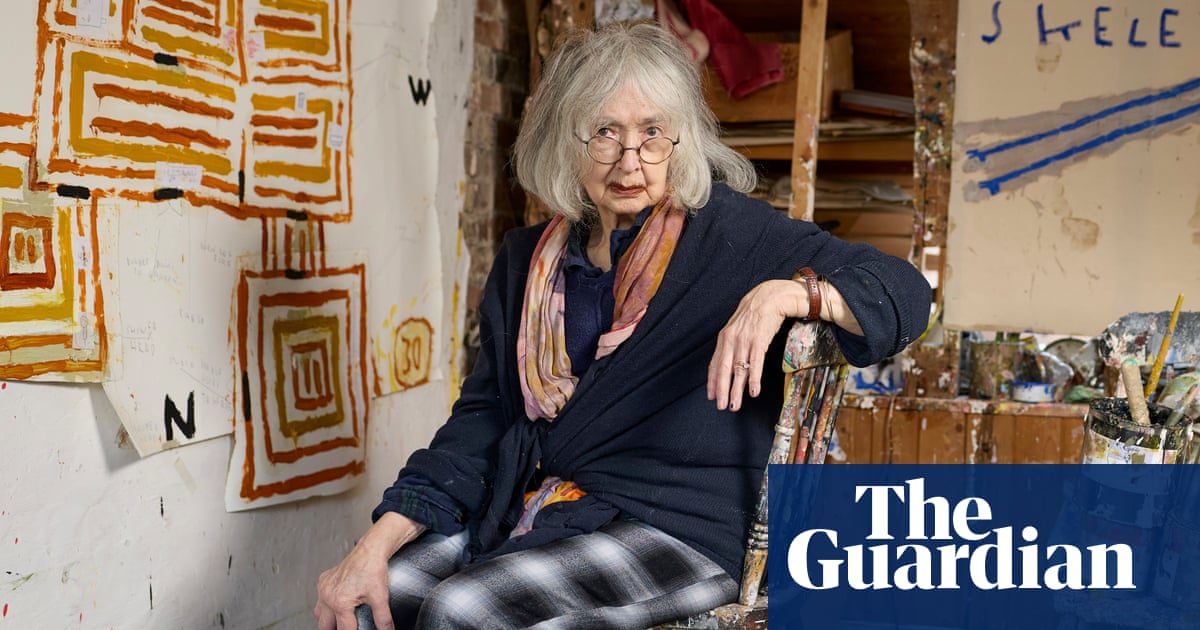
The Royal Academy in London is presenting Rose Wylie as a “rebel artist” in her forthcoming exhibition, marking a historic milestone as the first solo show by a British woman to occupy all of the institution’s main galleries. At 91 years old, Wylie continues to challenge the art establishment that has long underrated women’s work, bringing her distinctive giant canvases featuring bold colors, painted texts, and wild juxtapositions to one of Britain’s most prestigious venues.
The exhibition, titled “Rose Wylie: The Picture Comes First,” will run from February 28 through April 19 at the Royal Academy. Wylie’s unconventional paintings have drawn comparisons to Jean-Michel Basquiat and Philip Guston, though she rejects identification with any single movement and dislikes art that she describes as overly pretentious.
A Six-Decade Career from Her Kent Studio
For more than 60 years, the British artist has worked from her 17th-century house in Sittingbourne, Kent, where she maintains an unconventional creative environment. Her studio is carpeted with newspapers, which she prefers to concrete for the comfort it provides her back while painting. According to Wylie, the important thing is to work rather than clean, a philosophy that extends throughout her creative practice.
The artist’s work is driven by images she finds visually interesting, ranging from Roman mosaics and early Renaissance art to television and contemporary film. Her painting “Black Strap (Red Fly),” featuring Nicole Kidman at a Kent community centre, sold for £220,500 in 2021, demonstrating the significant market recognition she has achieved in recent years.
Late Recognition After Decades of Dedication
Wylie’s path to success was far from conventional. After studying at Folkestone and Dover Art School in the 1950s, she took 20 years away from her practice to raise her three children, explaining that she believed painting required emotional and mental involvement incompatible with active motherhood. However, she notes she was never angry about this choice, as working with children offered its own creativity.
The artist didn’t receive her major breakthrough until 2010, when she was 76 years old and selected for a group show at the National Museum of Women in the Arts in Washington DC. The same year, Germaine Greer visited her studio and subsequently wrote a piece that Wylie describes as very helpful. Following this attention, exhibitions in Hastings, Tate Britain, and interest from New York, Moscow, and Berlin quickly followed.
Rose Wylie’s Distinctive Artistic Vision
The artist’s work is characterized by marvellous contrasts and vast mental leaps that give her paintings their energy and wit. A curving footpath in her garden might become a gun and transform into a tribute to Werner Herzog’s 2009 film. She painted second world war bombs flying over the desert with a black duck added “for fun,” even though the city of Arezzo doesn’t actually have a duck as its emblem.
Additionally, Wylie’s subjects range from footballers to fairy-tale characters. She painted Ronaldinho, Thierry Henry, Wayne Rooney, and Peter Crouch together in her 2006 work “Yellow Strip,” inspired by watching Match of the Day with her late husband, painter Roy Oxlade. The footballers she chooses must have what she calls a certain something, preferring those who are either monumental or wispy in appearance.
Ambition and Future Projects
Meanwhile, Wylie emerged from motherhood with blazing ambition. She remembers seeing Steve McQueen’s Turner Prize-winning film “Deadpan” in 1997 and wanting to create something equally big and immersive. She began painting at scale and entering every competition available, producing increasingly confident work including aerial views of wartime London and interpretations of Snow White.
In contrast to artists content with regional success, Wylie has stated she wants to be in all the major museums around the world and become part of the history of visual culture. Currently, her work hangs in Los Angeles, Cologne, and Ghent, with another show planned in Paris featuring a series mapping her house and a dinner party with guests from Jane Austen.
The artist continues working until 3am on new projects, including a planned reinterpretation of Henri Rousseau’s “Unpleasant Surprise” where she intends to replace the original naked woman with a clothed Bette Davis. According to Wylie, Davis possesses the particular quality necessary to make a painting roar into life, citing her strong mouth as visually compelling. Her Royal Academy exhibition represents not only personal recognition but also a significant moment for British women artists in institutional spaces.